

For customers in Europe, Australia, Brazil, or the UK.
With Wise Interest, your money is held in government-guaranteed assets. Think of it as the government, and not the bank, keeping your money safe. In addition, the interest the government pays on that money is passed on to you. Because every dollar, pound, euro is backed by a government promise to pay it back to you, your money is held in some of the most secure assets available.
Note, the name for your 'main account' in Wise can vary based on your location. To find the exact terminology used in your region, please check the product directly.
How it works
When you use Wise Interest, your money is held in short-term government bonds. When you hold a government bond, you're essentially lending money to the government. A government might borrow money for different reasons— for example, to build schools or hospitals. In exchange, they promise to pay you back in full after a short period of time, including interest on the money borrowed. This interest is then passed on to you. All assets held in Wise Interest are ultimately backed by a government guarantee to pay you back.
With Wise Interest, you don't buy the bonds directly; instead, you hold your money in a fund — a financial 'pot' where many different people pool their money together. A professional fund manager invests it on behalf of the group, in this case, in short-term government bonds. They exclusively select assets backed by a government guarantee.
Why is the government guarantee important?
When your bank lends your money to people or businesses, there's always a chance that they can't pay the money back. But governments are different; countries are extremely unlikely to go bankrupt. This is especially true for governments like the US, UK, and Australia. This is because governments are the owners of their own currency and can decide to raise taxes or create money in order to pay off their debts.
The safest place in the world to hold US dollars is in the Federal Reserve, and the safest place to hold pounds is the Bank of England, because it's the creator of that money. Unfortunately, central banks don't take deposits from people and businesses directly. Wise Interest is designed to get as close as possible to holding your money directly at the central bank, passing on the central bank interest rate to you.
What are Interest rates, and how much can I earn using Wise Interest?
Interest rates affect everything from the mortgage you pay on your house to the interest you earn on your money. When interest rates are high, you'll pay a higher rate when borrowing money (e.g. on your mortgage), but at the same time, you'll be able to earn more on the money that you hold in your account.
A country’s central bank sets benchmark interest rates for its currency to control inflation and keep the economy healthy. Interest rates determine how much it costs to borrow money and, in return, determine how much someone can earn for lending money. This is why central bank interest rates impact how much money you'll earn when using Wise Interest.
Because Wise Interest invests in government-guaranteed short-term bonds, the interest you earn stays very close to the central bank's benchmark rate, unlike bank accounts where you often receive just a small return compared to the central bank rate. This is because banks are often reluctant to pass on the interest they earn.
See below how much interest the GBP Wise Interest fund has yielded after Wise and fund manager fees in comparison with the Bank of England benchmark interest rate.
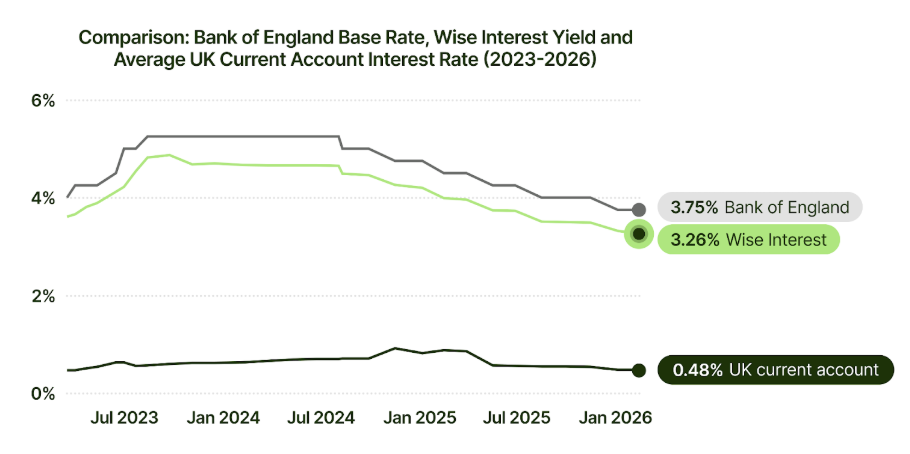
The graph shows the past performance of the Bank of England Base rate, the performance of the BlackRock ICS Sterling Government Liquidity Fund (which powers Wise Interest GBP) and the monthly average UK resident banks’ sterling weighted average interest rate. Past rates do not guarantee future growth.
How is Wise Interest different from a deposit bank account
When you deposit your money in a bank account, you're lending your money to the bank. Depositing money with a bank allows it to create new money to provide loans to customers and businesses. The risk is that the borrowers of the bank do not pay back their debt, or that too many people request their deposits at once. This is known as a run on the bank. To make sure that money held in a bank is safe, the government promises it will step in if a bank fails. They do this up until a certain amount of money. For example in the UK, the FSCS protects money held with a bank up to 120,000 GBP per customer.
With Wise Interest, you're effectively holding your money with the government. Regardless of the amount held, the government promises to pay back the money it's borrowing, including the interest rate. This guarantee from the government means that we don’t need to directly rely on deposit insurance like banks do. Similar to a ‘run on the bank’, there's a remote possibility that many people and businesses might request money held in government-guaranteed assets at once. In those instances, access to your money could be limited for a short period of time.
Did you know? Banks in the UK are holding more than £600bn in reserve accounts at the Bank of England, earning the benchmark rate [3.75% at the time of writing] on that money.
Can I get back less money than I put in?
Wise Interest funds are designed to maintain your money and not go down in value. With every investment you need to consider the risk, however remote it is.
The risk scenario for Wise Interest is that a government guaranteeing the assets goes bankrupt and isn't able to pay its debts. For example, your GBP Interest balance is at risk if the UK government defaults on their debt. Because governments can raise taxes or create more money to pay off their debt, this is extremely unlikely.
It may also be that the central bank changes interest rates close to zero or even negative. If you decide to keep holding money in Interest in this case, you’ll be earning negative returns and losing money. This would most likely happen to react to extreme events such as a global financial crisis.
Summary: Money held in Interest is considered very safe because it's backed by government-guaranteed assets. Your money going down in value is highly unlikely and would typically only occur during a catastrophic event, such as a national bankruptcy (e.g. United Kingdom not paying back its debt).
Remember, there's always a risk involved with holding money, depending on how and where it's held. Even if it’s held with a bank, your money is vulnerable to inflation and your deposit at a bank is only insured up to a certain amount.
More technical details
The type of fund that holds Wise Interest is called a public debt constant net asset value money market fund. The fund will invest the entirety of its net assets in money market instruments (i.e. debt securities with short term maturities) issued or guaranteed by the government. The fund may also invest in reverse repurchase agreements —very short-term loans (mostly overnight) to banks or the government that are secured by government bonds as collateral. This means that the fund would still hold the government bond in the unlikely event that a bank is unable to repay the loan. The fund may also hold a small portion of its assets as cash.
Summary: When you use Interest, your money is held in assets guaranteed by the government. You're essentially lending money, and the interest paid by the borrowers is passed to you. Every loan is ultimately backed by a government’s promise to repay.